On this page
A car that will not start is not automatically a dead battery. The lights, the sound from the engine bay and the way the car behaves when you turn the key separate a flat battery from a starter fault, a charging fault, a fuel problem or an immobiliser issue.
This is the order we use before recommending a jump start, a battery or a repair.
First: what happens when you turn the key?
| What you see or hear | What it usually points to |
|---|---|
| No lights, no dashboard, nothing | Battery completely flat, a terminal connection, or a main fuse |
| One loud click, then nothing | Battery voltage collapsing under load, or the starter solenoid |
| Slow, laboured cranking that gets worse over weeks | Battery losing capacity, often from heat or age |
| Rapid clicking | Low battery voltage, or a poor connection |
| The engine cranks normally but will not fire | Fuel, ignition, immobiliser or another fault — not the battery alone |
| The car starts after a jump, then is dead again next morning | Charging fault, or something draining the battery |
If the dashboard is completely dead, do not keep trying the starter. A repeated attempt can overheat the starter and drain a weak battery further.
Check 1: the lights and the dashboard
Turn the headlights on without trying to start the car.
- Bright lights: the battery has some charge. The fault may be the starter, fuel or ignition.
- Dim lights: the battery is low, or the connection is poor.
- No lights: the battery is flat, or the main connection/fuse has failed.
This is a quick clue, not a diagnosis. A battery can show good lights and still fail under cranking load.
Check 2: the battery terminals
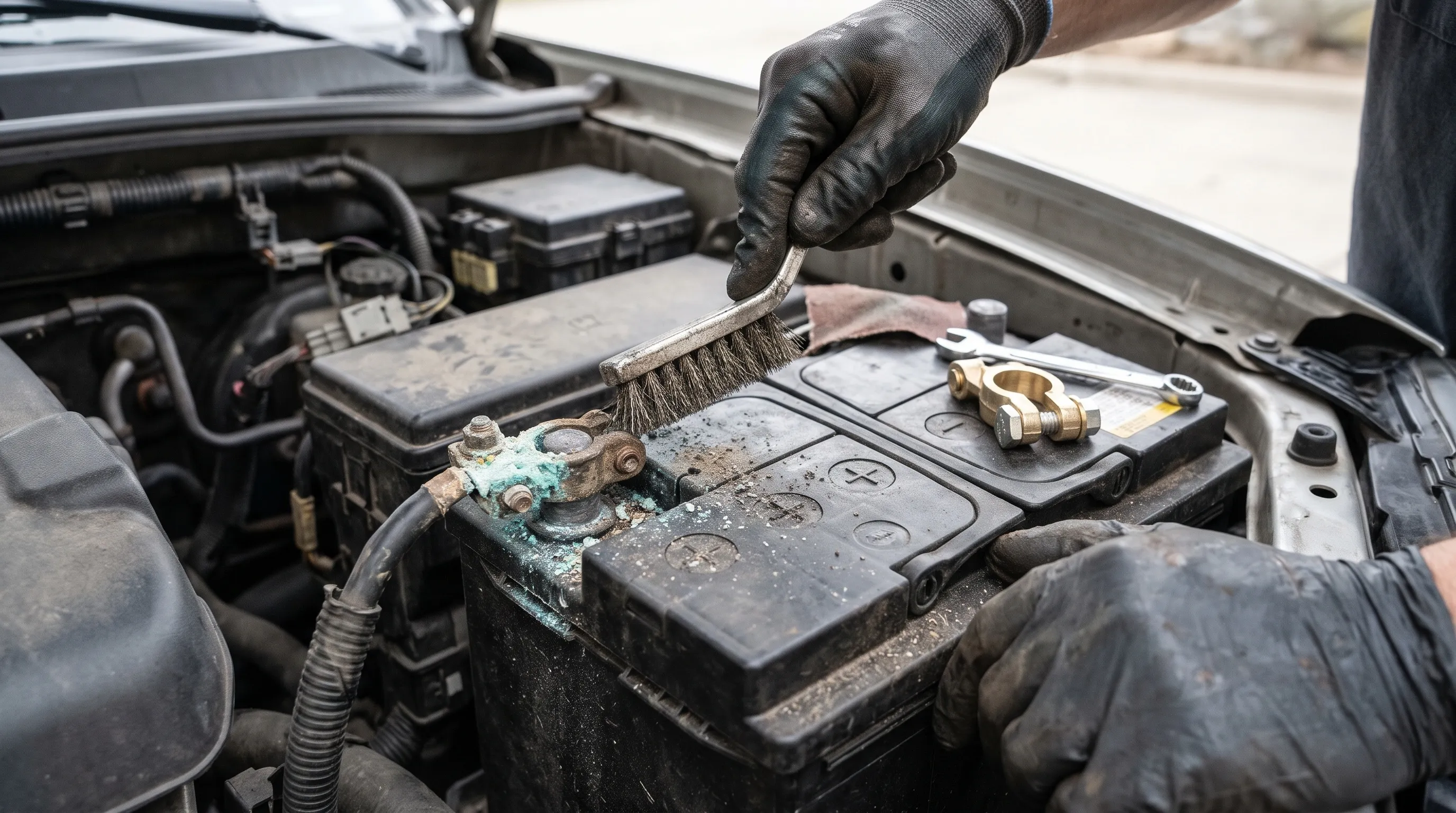
Look at the battery terminals and the cables. A loose clamp, heavy corrosion or a broken earth can mimic a dead battery.
Do not wiggle a terminal with metal tools while the car is live. If the terminal is loose or heavily corroded, call us and we will check it safely.
Check 3: battery voltage and load
A voltmeter reading tells you the state of charge. It does not tell you whether the battery can hold that voltage under cranking load. That is why a load test matters.
A healthy, fully charged battery sits in the low 12-volt range with the engine off. A reading in the low 11s means it is discharged, but it does not prove the battery is finished. A load test is the step that separates “flat” from “failed”.
Check 4: charging output
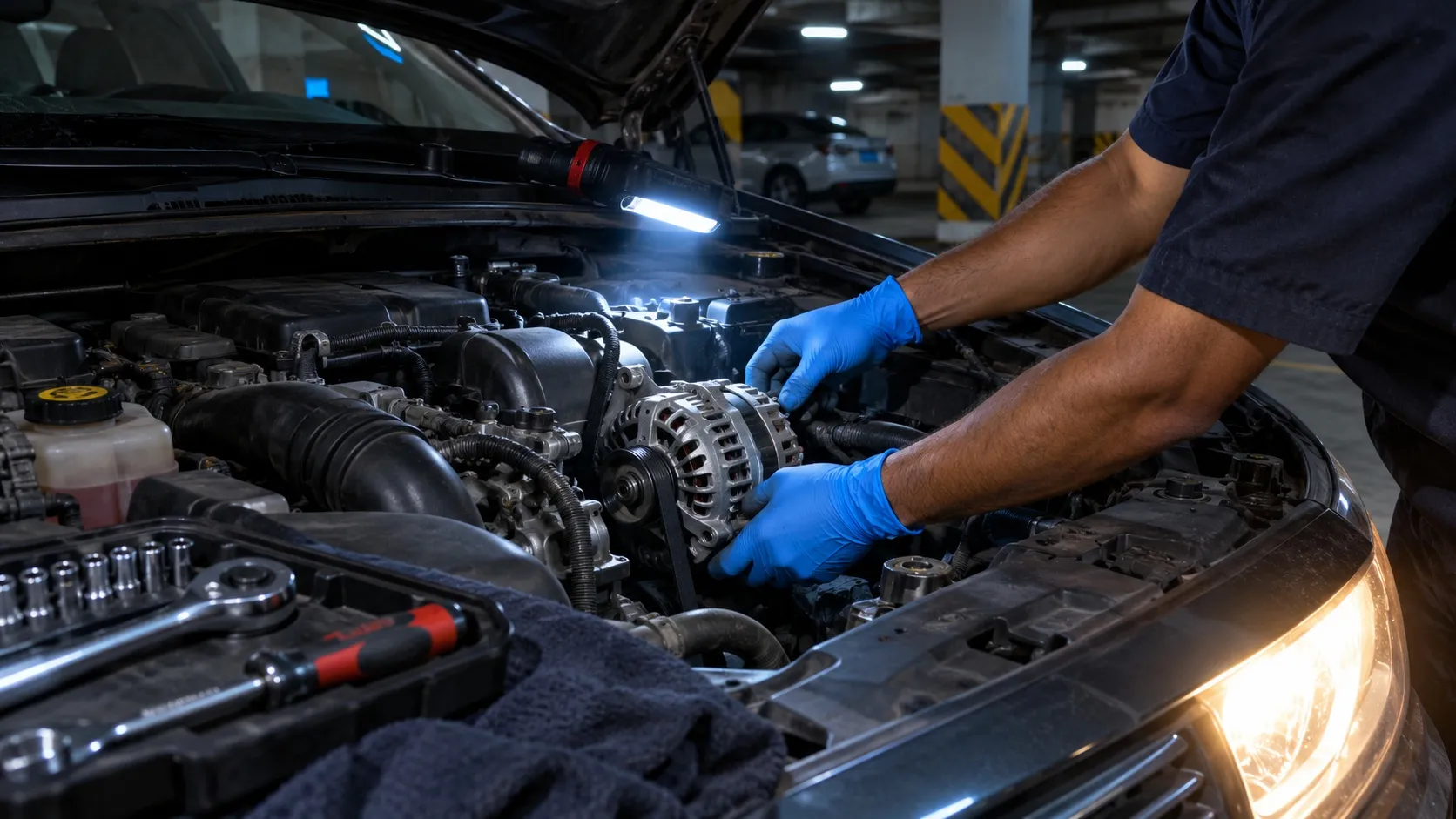
If the car starts after a jump, leave it running and have the charging output checked. An alternator that is not charging will flatten a healthy battery again.
The alternator, belt and wiring are part of the same circuit. A new battery cannot fix a charging fault.
Check 5: the starter circuit
If the lights are bright, the battery is charged and the car only clicks, the starter circuit needs testing. That includes the battery cables, earth straps, starter relay and the starter itself.
Some starter work can be done at the car. Some needs a workshop lift or specialist tooling. We confirm which applies before work begins.
What to do next
If the car is cranking slowly or the lights are dim
Call or WhatsApp with:
- the car’s make, model and year
- your location or nearest landmark
- what happens when you turn the key
- a photo of the battery label, if it is visible
We can jump start the car, test the battery and charging system, and confirm the price in writing before dispatch. If the battery has failed, you get a separate written price for the correct replacement.
If the car clicks once and does nothing
Do not assume the battery. Ask for a battery and starter-circuit check. A jump start may get it moving, but the cause still needs to be identified.
If the engine cranks but will not fire
This is usually not a jump-start job. It points to fuel, ignition, immobiliser or another fault. We diagnose what we can at the car and tell you if it needs a workshop.
If the battery is swollen, leaking or smells of rotten eggs
Do not jump start it. Keep away from the battery and call for advice. A swollen battery can be unsafe.
What not to do
- Do not connect the jump leads in the wrong order.
- Do not use a donor car with a different voltage system unless you know the procedure.
- Do not keep cranking a car that will not fire; you can overheat the starter.
- Do not replace the battery before the charging system is tested.
- Do not jump start a battery that is visibly damaged or leaking.
The honest answer
A no-start can be a five-minute battery job or a longer diagnosis. The only safe way to know is to test the battery, the connections and the charging output before replacing parts.
Call or WhatsApp with the car details and what you can see and hear. We will tell you what the next step should be — and if the job needs a workshop, we will say so.